
Somali culture is deeply rooted in resourcefulness and artistry. For centuries, nomadic families have crafted their essential tools from the local environment—using desert plants, fibers, and skins to create durable, beautiful, and functional items. Here is a detailed look at the traditional Somali household kit.
1. The Baaquli (The Woven Bowl Set)
The Baaquli is a unique fusion of imported materials and local weaving. It consists of two main parts:
- The Metal Bowl: A hollow, imported metal container used for liquids or food, often decorated with vibrant colors on its surface.
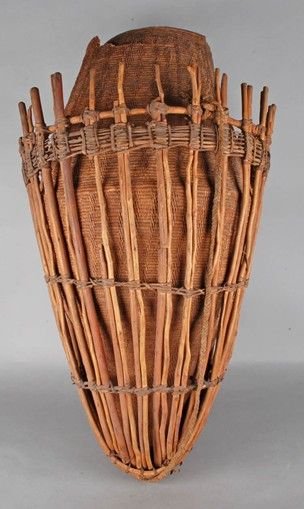
- The Sati (The Woven Case): Handwoven from Caw (natural fibers/straw), the Sati consists of a base and a tall lid. The base holds the metal bowl securely, while the lid features a wide opening, a narrow neck, and a sturdy bottom to stand upright when placed on the ground.
2. The Haan (The Water and Milk Vessel)
The Haan is perhaps the most iconic Somali vessel, primarily used for storing milk or water.
- Material: It is woven from the roots of the Argeeg tree or branches of the Qabo tree.
- The Process: To prepare the wood, the Qabo branches are lightly burned to remove thorns and sap. The bark is then stripped, and the inner fibers are split into fine strands for weaving.
- The Finish: Once the Haan and its accompanying cup (Aagaan) are woven, they are treated with a natural preservative and dye called Asal, extracted from the bark of the Qaroon tree.
The Dhiil (The Milk Jar)
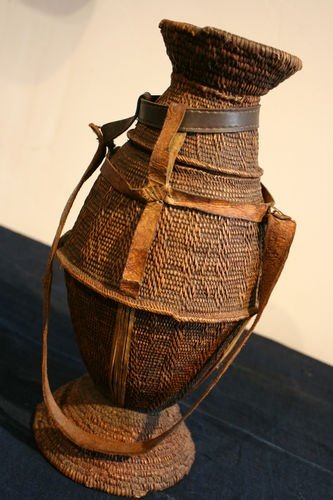
Similar to the Haan but typically smaller and more slender, the Dhiil is essential for churning or storing milk.
Components: A complete Dhiil set includes the jar itself, a drinking cup (Haruub), leather carrying straps (Suuman), and decorative seashells (Aleel). The exterior is often intricately decorated with braided leather fringes to signify the owner’s pride in their dairy livestock.
Construction: It is also made from the processed fibers of the Qabo tree.
4. The Derma (The Woven Mat)
The Derma is a versatile mat used primarily for sleeping (Gogol).
Usage: A Derma has two sides—one textured and one smooth. For comfort, the smooth side is used for sleeping. These mats are common in both rural nomadic huts and urban homes.
Craftsmanship: It is expertly plaited by Somali women using colorful Caw fibers. After the fibers are harvested and dried, they are dyed in various hues to create geometric patterns.
5. The Cayn (The Camel Girth)
In a nomadic society, transportation is key. The Cayn is a heavy-duty rope used to secure loads on camels.
- Material: It is braided from animal hides. The hair is first scraped off the skin, which is then treated (tanned) with Asal.
- Design: The hide is cut into four or six long strips and tightly braided together, ending in a decorative tassel (Bul).
- Function: It is wrapped under the camel’s belly (the Awr) to ensure that the household goods remain stable during long migrations.
6. The Udub or Tiir (The Central Pillar)
The Udub is the backbone of the traditional Somali portable house (Aqal Soomaali).
- Structure: It is a sturdy wooden post carved from specific hard-timber trees. It features two “forked” ends (Ganood) at the top to support the roof’s weight, while the bottom is sharpened to be driven into the earth.
- Significance: The house cannot stand without the Udub. It is often polished and decorated with carvings (Xarar) as it represents the stability of the home.
7. The Gembiso (The Storage Basket)
The Gembiso is a protective container used to store dry foods and fragile items.
Storage: It is used to keep dry staples like rice, sugar, sorghum, beans, and grains safe from pests and moisture. It is a testament to the organizational skills of Somali women in the interior..dhaqandhawr.com
The Frame (Saab): Made from thin, flexible branches that are heat-treated over a fire to prevent breaking, then reinforced with strips of goatskin.
The Lid (Aabur): Woven from Caw fibers and covered in leather or cloth for durability.